🍿 PopcornCheck
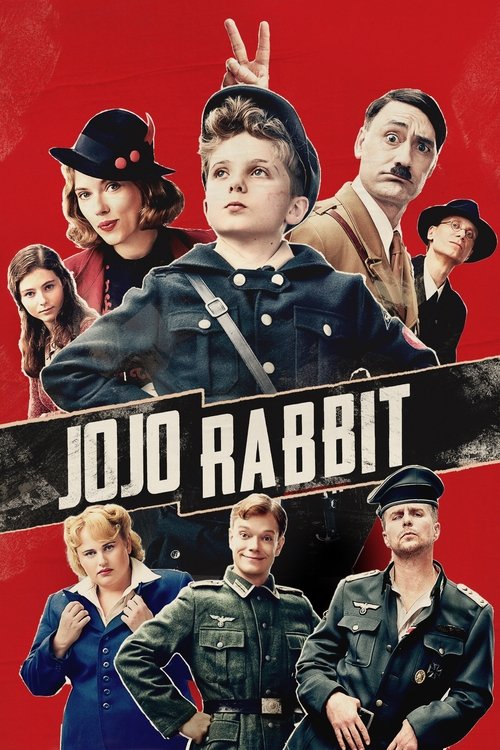
Jojo Rabbit poster

Is Jojo Rabbit OK for Kids?

ComedyWarDrama
13+
PG-13⭐ 7.9 / 102019 · 1h 48m
Taika Waititi

Where to Watch

United States

Stream

fuboTVYouTube TVFXNow

Rent

Amazon VideoApple TV StoreGoogle Play MoviesYouTubeFandango At Home
Rent or Buy on Amazon

Streaming data by JustWatch

What's In It

Based on the actual screenplay
πŸ—‘οΈViolence
Extremeβ–Ό
Moments in the script, mildest β†’ most intense
1
Cartoon / Comedic
2
Action & Peril
1
Injuries & Death Shown
3
Graphic & Disturbing
  • In an early fantasy sequence, Jojo imagines killing a rabbit with exaggerated ease in a cartoonish, comedic style β€” other children then mock and taunt him as a coward for refusing to do it in real life.
  • A training montage shows Hitlerjugend children throwing knives, firing rifles, and participating in mock war games β€” weapons are prominently featured and handled by minors throughout.
  • Jojo accidentally detonates a hand grenade during training; the explosion throws him through the air and leaves him hospitalised with visible facial scars and a permanently limp arm shown throughout the rest of the film.
  • In the film's most emotionally devastating scene, Jojo walks through the town square and recognises his mother's shoes on a hanged body β€” she has been executed alongside other resistance members and her body is displayed publicly.
  • The final act features street combat between German soldiers and Allied forces, including machine gun fire directed at Jojo's friend Yorki, tank warfare, explosions, and widespread destruction as Vienna falls.
  • Public executions of Nazi officers and collaborators by firing squad and hanging are depicted as the war ends β€” multiple deaths are shown in the final sequence.
  • The overall tone of violence mixes dark absurdist comedy in early scenes with increasingly graphic and emotionally serious violence as the film progresses β€” the tonal shift is intentional and significant.
πŸ’¬Language
Extremeβ–Ό
Moments in the script, mildest β†’ most intense
3
Mild Words
(damn, hell)
11
Moderate
(ass, b**ch)
0
Strong
(sh*t)
2
Extreme
(f**k)
  • Mild words used: 'hell' (Γ—2), 'p**s' (Γ—1) β€” nothing beyond what most school-age children have heard.
  • Moderate words used: 's**t' (Γ—8), 'da**' (Γ—3) β€” used across various characters and contexts throughout the film.
  • Strong language: 'f**k' is used twice β€” parents of younger teens should be aware this appears despite the film's overall comedic tone.
  • No c-word, racial slurs in English, or other extreme profanity detected in the extraction.
πŸ‘»Scary Scenes
Extremeβ–Ό
Moments in the script, mildest β†’ most intense
1
Mildly Tense
1
Startling Moments
1
Genuinely Scary
2
Deeply Disturbing
  • Elsa suddenly appears from inside the hidden wall cavity and threatens Jojo with a knife β€” a startling jump-scare-style moment that is tense and unexpected.
  • A classroom scene features a teacher delivering antisemitic propaganda about Jewish people with disturbing conviction, followed by a book burning scene β€” deeply unsettling in its normalisation of hatred.
  • Gestapo agents conduct a full house search while Elsa poses as Jojo's deceased sister Inga β€” the prolonged identity verification scene is among the film's most sustained and genuinely frightening sequences, with life-or-death stakes for Elsa.
  • Jojo's discovery of his mother's hanged body in the town square is the film's most disturbing and traumatic scene β€” shown clearly and without softening, it is the emotional core of the film.
  • Elsa panics after a false report that Nazi Germany has won the war, confronting her complete loss of hope β€” a psychologically intense and deeply upsetting moment.
  • Scary scenes are largely resolved through the film's emotional arc toward liberation and human connection, but the trauma of the mother's death is not softened or quickly overcome.
πŸ’•Romance
Moderateβ–Ό
Moments in the script, mildest β†’ most intense
2
Crushes & Holding Hands
1
Kissing & Dating
1
Suggestive
0
Sexual Content
  • Jojo has an innocent crush on a girl named Gudrun at Hitlerjugend training β€” she later rejects him after his injuries, a brief and age-appropriate storyline.
  • Jojo develops feelings for Elsa while she hides in his home β€” he experiences butterflies and, in one instance, watches her bathe, which is worth noting for parents of younger viewers.
  • Elsa offers to kiss Jojo to comfort him about his appearance after his injuries; they hold hands β€” the moment is tender and innocent rather than sexual.
  • Elsa describes a romantic riverbank proposal from her late boyfriend Nathan, talking about love and dancing β€” suggestive in emotional tone but not in content.
  • No sexual content, nudity, or explicit intimacy is depicted.
🍺Substances
Moderateβ–Ό
Moments in the script, mildest β†’ most intense
1
Mentioned in Passing
0
Shown Casually
1
Featured Prominently
0
Glorified or Abused
  • The imaginary Adolf Hitler character smokes cigarettes throughout the film and repeatedly offers cigarettes to ten-year-old Jojo β€” the offer is played for satirical dark comedy but cigarette smoking is shown casually and repeatedly.
  • Alcohol and drinking are referenced in wartime dialogue but are not depicted prominently on screen.
  • Substance use is not glorified β€” the Hitler character is portrayed as ridiculous and buffoonish, which contextualises his behaviour as something to mock rather than emulate.
⚑Stimulation
Extremeβ–Ό
Moments in the script, mildest β†’ most intense
0
Gently Engaging
1
Exciting
2
Intense
1
Overwhelming
  • The Hitlerjugend training sequences are energetic and exciting with physical challenges, competitions, and a fast-moving montage format β€” engaging but not overwhelming.
  • The grenade explosion sequence and Jojo's subsequent hospitalisation are edited with intensity β€” loud, sudden, and visually jarring with the aftermath shown through scarring and injury.
  • The final battle for Vienna is the film's most overwhelming sequence β€” chaotic street combat with gunfire, explosions, tank warfare, and the immediate discovery of casualties including Jojo's mother.
  • The film's tonal swings between whimsical comedy and graphic wartime reality may be disorienting and emotionally intense for younger or sensory-sensitive viewers β€” not recommended for children under 10 for stimulation reasons alone.
Jojo Rabbit β€” Heads Up for Parents

Despite the film's whimsical marketing and comedic tone, the scene where Jojo walks through the town square and recognises his mother's shoes on a hanged body β€” displayed publicly alongside other executed resistance members β€” is profoundly traumatic and arrives with very little warning; many parents report being caught completely off guard by its emotional severity.

About Jojo Rabbit

Jojo Rabbit is a World War II dark satire set in Nazi Germany, following a lonely ten-year-old boy named Jojo whose imaginary friend is a buffoonish version of Adolf Hitler. When Jojo discovers that his mother has been secretly hiding a Jewish teenage girl named Elsa in the walls of their home, his indoctrinated worldview begins to crack. The film balances absurdist comedy with genuine emotional weight, exploring how propaganda corrupts children and how human connection can overcome hatred.

πŸ‘¨β€πŸ‘§
Best watched together
The film's satire of Nazi ideology and antisemitism requires historical context to fully understand, and scenes including Jojo's discovery of his mother's execution and the Gestapo house search are emotionally heavy β€” teens aged 13–15 in particular will benefit from a parent present to discuss the film's themes of propaganda, resistance, and moral courage.

Family Takeaways from Jojo Rabbit

What it gets right

  • βœ“The film uses Jojo's perspective to show exactly how propaganda works on children β€” his imaginary Hitler is ridiculous and buffoonish, making it clear that the ideology is absurd while also showing how easily a lonely child can be manipulated by it.
  • βœ“Elsa and Jojo's bond β€” built through conversations about art, poetry, and beauty β€” demonstrates that prejudice dissolves through personal connection, a lesson shown through specific, earned scenes rather than stated as a message.

Jojo Rabbit Cultural & Values Guide

Cultural & Values Guide

Faith & Religion
●Jewish themes

The film centers on a Jewish girl hiding from Nazi persecution, with her Jewish identity being central to the plot and danger she faces. The Holocaust and anti-Semitism are core elements driving the entire narrative.

●Religious mockery depicted

The film deliberately satirizes Nazi ideology and Hitler worship through Jojo's imaginary friendship with a buffoonish version of Hitler. Nazi racial theories and hero worship are systematically ridiculed throughout.

Community Notes

  • Some Jewish critics and community members have raised concerns that using Hitler as a comedic imaginary friend risks trivialising the Holocaust or making Nazi ideology palatable through humour β€” director Taika Waititi, who is part-Jewish, has addressed this directly but the debate remains active.
  • Some educators caution that younger viewers without sufficient historical grounding may misread the film's satire and not fully understand that the ideology being mocked was responsible for the murder of millions.

Cast:Roman Griffin DavisThomasin McKenzieScarlett JohanssonTaika WaititiSam Rockwell

Is Jojo Rabbit Appropriate for Your Child's Age?

βœ—Age 5: Not recommended for 5-year-olds
βœ—Age 8: Not recommended for 8-year-olds
βœ—Age 10: Not recommended for 10-year-olds
βœ—Age 12: Not recommended for 12-year-olds
βœ“Age 13: Generally appropriate for 13-year-olds
βœ“Age 15: Generally appropriate for 15-year-olds
βœ“Age 17: Generally appropriate for 17-year-olds

Individual children may vary β€” use your judgment.

Parents also ask about Jojo Rabbit

  • Is Jojo Rabbit appropriate for a 13-year-old?
  • Does Jojo Rabbit have violence?
  • Is Jojo Rabbit OK for kids?
  • What is the age rating for Jojo Rabbit?