🍿 PopcornCheck
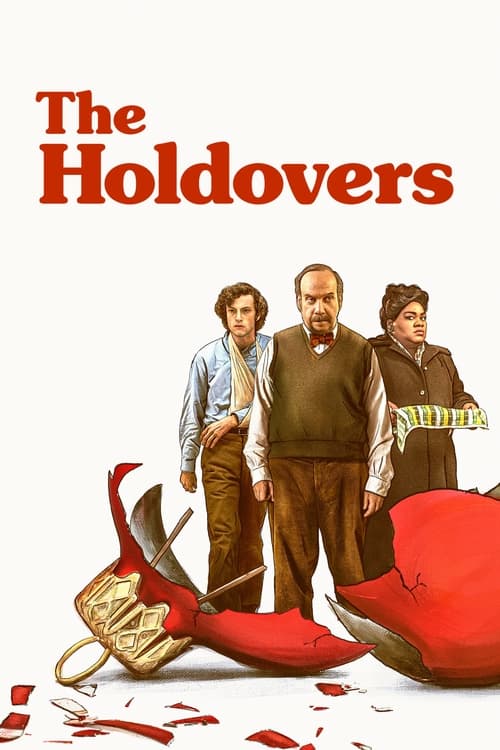
The Holdovers poster

Is The Holdovers OK for Kids?

DramaComedy
16+
R⭐ 7.9 / 102023 · 2h 13m
Alexander Payne

Where to Watch

United States

Stream

Peacock PremiumPeacock Premium Plus

Rent

Amazon VideoApple TV StoreGoogle Play MoviesYouTubeFandango At HomeFlixFling
Rent or Buy on Amazon

Streaming data by JustWatch

What's In It

Based on the actual screenplay
πŸ—‘οΈViolence
Extremeβ–Ό
Moments in the script, mildest β†’ most intense
0
Cartoon / Comedic
3
Action & Peril
1
Injuries & Death Shown
1
Graphic & Disturbing
  • Angus dislocates his shoulder playing hockey on the gym floor; the scene includes him screaming in pain as a doctor manually relocates the joint β€” medically intense but not gory.
  • Two boys grapple and struggle in a dormitory fight until Mr. Hunham physically separates them.
  • Paul (likely Mr. Hunham's reference to his past) mentions hitting someone with a car at Harvard, breaking three ribs β€” described verbally, not shown.
  • Curtis Lamb's death in Vietnam is referenced throughout the film as a source of grief for his mother Mary β€” no combat is depicted on screen, but the emotional weight is significant.
  • Local men harass Angus at a bar; Mr. Hunham intervenes and defuses the situation by buying them drinks β€” tense but resolved without physical harm.
  • Violence overall is low-frequency and consequence-focused rather than action-oriented; the film is a drama and no weapons are used on screen.
πŸ’¬Language
Extremeβ–Ό
Moments in the script, mildest β†’ most intense
20
Mild Words
(damn, hell)
42
Moderate
(ass, b**ch)
18
Strong
(sh*t)
49
Extreme
(f**k)
  • f**k/f**king used 47 times β€” by far the most frequent strong word in the film.
  • s**t used 18 times; a**/a**hole used 15 times; da**/godda** used 12 times; hell used 8 times.
  • b**ch used 4 times; d**k/dickhead used 3 times; pr**k used 2 times.
  • c**t used once; 'penis cancer' deployed as a crude insult once.
  • Strong and extreme profanity is used casually by both adult and teenage characters throughout, making this one of the most significant content flags for parents.
πŸ‘»Scary Scenes
Extremeβ–Ό
Moments in the script, mildest β†’ most intense
2
Mildly Tense
1
Startling Moments
0
Genuinely Scary
1
Deeply Disturbing
  • Angus visits his father in a mental facility β€” his father appears confused, heavily medicated, and believes people are poisoning him; this is the film's most disturbing scene and may be upsetting for children who have family members with mental illness.
  • Angus fears he will become like his father, with references to paranoid schizophrenia and early-onset dementia β€” a prolonged psychological anxiety that runs through the film.
  • Angus wakes from a nightmare, cries heavily, and has had a bedwetting accident β€” a startling, emotionally raw scene.
  • The threat of being sent to Fork Union Military Academy looms as a consequence for misbehaviour β€” presented as genuinely frightening to the boys.
  • Scary and disturbing content is psychological and emotionally grounded rather than horror-based; there are no monsters or supernatural elements, but the mental illness depiction is the most challenging aspect for sensitive viewers.
πŸ’•Romance
Moderateβ–Ό
Moments in the script, mildest β†’ most intense
1
Crushes & Holding Hands
1
Kissing & Dating
3
Suggestive
0
Sexual Content
  • Angus develops a crush on Elise, Miss Crane's niece, at a Christmas party; they kiss under the mistletoe while finger-painting together in a basement β€” sweet and age-appropriate.
  • Miss Crane and Mr. Hunham share a mutual attraction; their extended conversation at the Christmas party includes flirtatious behaviour on Miss Crane's part.
  • A woman approaches Mr. Hunham on the street and offers sexual advances; he declines β€” brief and not elaborated upon.
  • Mr. Hunham makes a verbal reference to a time when 'fire in loins burned white hot,' a suggestive but comedic remark about his past.
  • No nudity or sexual scenes are depicted; romantic content is largely implied or verbal.
🍺Substances
Moderateβ–Ό
Moments in the script, mildest β†’ most intense
1
Mentioned in Passing
2
Shown Casually
3
Featured Prominently
0
Glorified or Abused
  • Teenage students β€” including Angus β€” smoke marijuana outdoors near the school; the scene is shown on screen without immediate negative consequence.
  • Boys discuss trading marijuana ('ditch weed'), with Teddy noted as having enough pot to last through Christmas and Kountze attempting to sell it β€” normalised among the student group.
  • Mr. Hunham drinks alcohol regularly throughout the film, with Jim Beam whiskey, Miller High Life beer, and wine all shown on screen β€” presented as a habitual coping mechanism.
  • Mr. Hunham takes Librium (a benzodiazepine) for anxiety and depression β€” shown casually without dramatisation.
  • Boys discuss stealing cigarettes and reference pornography/skin magazines in conversation.
  • Substance use among both teenagers and the adult supervisor is a recurring and prominent element of the film.
⚑Stimulation
Moderateβ–Ό
Moments in the script, mildest β†’ most intense
0
Gently Engaging
1
Exciting
3
Intense
0
Overwhelming
  • The shoulder dislocation and relocation scene is the film's most physically intense sequence β€” includes loud screaming, visible pain, and rapid breathing; likely distressing for sensory-sensitive viewers.
  • A kitchen explosion during the New Year's celebration produces a loud bang β€” startling but brief.
  • A confrontation scene where Mr. Hunham and Angus argue intensely, Angus runs and Hunham chases, with threats of suspension β€” emotionally charged and high-tension.
  • Angus's extended emotional breakdown at the sanitarium about his fear of hereditary mental illness is slow-paced but deeply heavy β€” may be emotionally overwhelming for sensitive children.
  • The film's overall pacing is slow and dialogue-driven; intense moments are emotional rather than action-based, but the cumulative emotional weight is significant.
The Holdovers β€” Heads Up for Parents

Despite its period setting and awards-drama tone, the film contains prominent on-screen marijuana use by teenage characters β€” including a scene where Angus and friends smoke together outdoors β€” which may surprise parents expecting a more conservative school story; this is shown without immediate consequence and normalised among the student group.

About The Holdovers

Set at a New England boarding school in 1970, The Holdovers follows Paul Hunham, a curmudgeonly classics teacher forced to supervise students who cannot go home for Christmas break, including troubled teenager Angus Tully and the school's grieving cook Mary Lamb. Over the holiday, the three form an unlikely bond as they each confront painful secrets about family, loss, and identity. The tone is warm and melancholic β€” a character-driven drama with flashes of dark humour.

πŸ‘¨β€πŸ‘§
Best watched together
The film's depictions of parental abandonment, hereditary mental illness, teenage marijuana use, and Mr. Hunham's habitual drinking are rich but heavy β€” teenagers 16+ will gain most from watching with a parent who can discuss the difference between coping and self-destruction, and what it means to sacrifice something for someone else's future.

Family Takeaways from The Holdovers

What it gets right

  • βœ“The film portrays mental illness with sensitivity and specificity β€” Angus's visit to his father at the sanitarium and his fear of hereditary schizophrenia are handled with emotional honesty, making it a rare mainstream film that treats this subject seriously rather than sensationally.
  • βœ“Mr. Hunham's decision to take full blame for the Boston trip β€” knowing he will be fired β€” is a powerful depiction of adult integrity and the willingness to prioritise a child's future over personal self-interest.

The Holdovers Cultural & Values Guide

Cultural & Values Guide

Faith & Religion
●Christian themes

The film is set over the Christmas period at a New England boarding school and includes chapel services, hymns, Christmas celebrations, prayer, and Biblical references as part of the school's institutional culture β€” faith is a background presence throughout rather than a central narrative driver.

Community Notes

  • Some viewers have noted that the film's portrayal of a paranoid schizophrenic parent in an institutional setting, while empathetic, relies on familiar imagery of medication and confusion that mental health advocates consider reductive.
  • The casual normalisation of teenage marijuana use by sympathetic characters, without depicted consequences, may concern parents seeking films that model abstinence or present substance use critically.

Cast:Paul GiamattiDominic SessaDa'Vine Joy RandolphCarrie PrestonBrady Hepner

Is The Holdovers Appropriate for Your Child's Age?

βœ—Age 5: Not recommended for 5-year-olds
βœ—Age 8: Not recommended for 8-year-olds
βœ—Age 10: Not recommended for 10-year-olds
βœ—Age 12: Not recommended for 12-year-olds
βœ—Age 13: Not recommended for 13-year-olds
βœ—Age 15: Not recommended for 15-year-olds
βœ“Age 17: Generally appropriate for 17-year-olds

Individual children may vary β€” use your judgment.

Parents also ask about The Holdovers

  • Is The Holdovers appropriate for a 16-year-old?
  • Does The Holdovers have violence?
  • Is The Holdovers OK for kids?
  • What is the age rating for The Holdovers?